



























PCST 360

IGG’s third annual report exploring attitudes towards the Professional 
Corporate Sole Trustee model.

Introduction

This January 2026 edition of our PCST 360 report is IGG’s third deep dive into the growing market for the Professional Corporate Sole Trustee (PCST) model, helping sponsors manage workplace pension schemes more effectively.


Building on previous research, the report explores current adoption levels, market sentiment and expectations for future growth, alongside the practical impact of PCST on scheme governance.

Methodology

The findings in this report draw on insights from:


  • 12 advisory firms, who collectively advise almost 10,000 pension schemes, including more than
  • 850 schemes operating under the PCST model.
  • 19 sponsoring employers whose schemes have transitioned to the PCST model.

This combined perspective provides both a market-wide view and direct sponsor experience of operating under the PCST model.

Based on research carried out in November 2025. With thanks to the late Andy Lane, whose exceptional analytical insight and dedication to this report were central to its development.

If you would like to find out more please contact:

PCST Market Outlook

PCST adoption continues to rise, with further growth expected in 2026

PCST has moved quickly from an emerging option to an established governance model in the UK pensions market.


A host of studies from advisory firms, including LCP and Hymans Robertson, show that 20 – 25% of UK pension schemes now use the PCST model, up from 12% in 2021. This highlights the pace at which the PCST model has been adopted over a relatively short period.


IGG’s PCST 360 report suggests firms remain largely positive that this growth will continue into 2026.


  • A clear majority of advisory firms (83%) expect a significant or slight increase in growth, even though confidence is lower than for 2025 when 93% said the same.
  • Only one firm expects demand to remain unchanged.
  • Only one firm, for the first time, anticipates a slight decline.

Overall, the message is clear. PCST is no longer viewed as niche. The moderation in growth expectations reflects a maturing market as schemes and advisers continue to see PCST as a practical response to increasing governance complexity and resourcing pressures.

What factors are predicted to drive a significant increase in demand?

0%

of advisory firms
expect a significant
increase in demand

Firms with strong growth expectations highlight three factors:

Existing professional trustee appointments moving to PCST

Many schemes where a professional trustee is already appointed intend to move to PCST in the next 12-18 months.

Increasing regulatory and market complexity

Development in TPR’s oversight framework and managing 
the complexities of the current market environment.

A widening pool of suitable schemes

The profile of schemes adopting PCST continues to broaden.

More mid-to-large schemes are being impacted by the factors which have driven smaller 
schemes to adopt the PCST model.

The expectation of significant growth is not driven by a single factor, but by a combination of structural change, regulatory pressure and evolving scheme needs, reinforcing the PCST model’s position as a mainstream governance solution.

What factors are predicted to drive a slight increase in demand?

0%

of advisory firms
expect a slight
increase in demand

Firms with modest growth expectations consistently point to a common set of underlying factors:

The need for faster, more 
detailed decision-making

Executing risk transfer activity efficiently requires pace, technical expertise and clear accountability. As schemes look to progress complex transactions, PCST is seen as a governance structure better suited to supporting timely, informed decisions.

Increasing governance
requirements complexity

Ongoing regulatory change and heightened scrutiny continue to raise the bar for trustee 
governance. For many schemes, this is gradually increasing the appeal of professionalised models that reduce pressure on lay trustees.

Challenges in trustee recruitment

Difficulties in finding and retaining 
member or employer-nominated trustees are becoming more widespread. PCST offers a practical alternative where traditional trustee models are proving harder to sustain.

Greater focus driven by DWP consultation

The DWP’s consultation on trustees and governance has helped refocus attention on trustee effectiveness and board composition, reinforcing the role of professional trusteeship in meeting higher governance expectations and delivering robust outcomes.

Growing consensus on professional governance

There is an increasing recognition across the market that more professionalised trustee boards tend to deliver better, more consistent outcomes. This shift 
in mindset is supporting gradual, ongoing growth in PCST adoption.

The expectation of a slight increase reflects a market responding steadily to governance pressure points, rather than a single catalyst. PCST demand is being shaped by practical realities, reinforcing its role as a sustainable long-term governance option.

What factors are predicted to weigh down on demand?

0%

of advisory firms
expect demand will
be unchanged or
slightly drop

Firms who expect demand to remain stable or fall suggest:

Alternative governance solutions already adopted

Many sponsors have already considered the PCST model 
and adopted an alternative, 
so continued adoption will be 
a slow process.

Fewer direct moves to PCST

Advisers are seeing fewer 
immediate transitions to PCST, alongside a rise in tender 
activity for co-trustee roles 
instead. This suggests some 
schemes are opting for partial governance changes rather than 
full structural shifts.

Limited new market triggers

Some firms point to a lack of 
strong new market signals that 
would drive a significant change 
in demand compared with 
previous years. Without a clear 
catalyst, adoption may remain 
steady rather than increase sharply.

Where demand is expected to soften, it reflects market saturation and timing rather than dissatisfaction with the PCST model. For most schemes, the PCST model remains a viable option, but adoption decisions are increasingly shaped by existing governance choices and broader market conditions.

What do advisory firms see as driving consideration for the PCST model among sponsors?

Efficiency, expertise and ensuring continuity are seen as the key factors driving the PCST model

What do advisory firms see as the main barriers to consideration?

Concerns over participation and perception stand in the way of wider PCST adoption

Implementing The
PCST Model

Initiating a move to PCST

Moves to the PCST model are now predominantly sponsor-led. All advisory firms surveyed (100%) report that transitions to PCST are primarily initiated by sponsors, up from 73% last year and 53% in 2022.

This shift suggests increasing pressure on existing governance arrangements, with sponsors taking a more proactive role in reviewing whether current structures remain fit for purpose.

What is driving sponsor-led change?

Several factors are contributing to this trend:

  • Growing strain on existing governance models
    Sponsors are increasingly reassessing their arrangements as complexity, regulatory scrutiny 
and decision-making demands continue to rise.
  • Succession planning pressures
    Succession planning is a key trigger for PCST discussions, whether change is trustee-led and 
adviser-led. This is particularly relevant where co-trustees are approaching planned exits 
and boards are reassessing long-term structure.
  • Need for greater specialist expertise
    Adviser-led recommendations often reflect a view that trustee boards require deeper 
or more specialist expertise to manage today’s challenges effectively.
  • Desire for greater efficiency
    Sponsors also cited concerns around cost and slower decision making as background factors triggering PCST discussions.


When asked about their concerns before switching to the PCST model, IGG’s research shows that more than one in three has no concerns before switching.

Overall takeaway

The move to a PCST is less about reacting to isolated issues and more about sponsors taking a strategic view of governance sustainability. As pressures build, the PCST model is increasingly being considered as part of a forward-looking review of long-term trustee arrangements.

What do sponsors gain from the PCST model?

Four main benefits experienced by sponsors when adopting the PCST model for the first time are:

Governance

Every scheme reported improved governance, with 58% seeing 
a significant uplift – which bodes well for member experiences and outcomes.

Efficiency

Four in five (79%) now spend less time on pensions, helping sponsors focus on other priorities.

Expertise

Around four in five sponsors (79%) cite increased professional expertise as a key benefit 
of the model.

Decision-making

Over half of sponsors (53%) report quicker decision-making, with 37% naming it as the main benefit.

Overall takeaway

Concerns around PCST are largely about perception. In practice, schemes consistently report stronger governance, greater efficiency, deeper expertise and faster decision-making once the model is implemented.

Quicker decisions and increased expertise are the biggest gains

The main benefit sponsors experience when switching to PCST

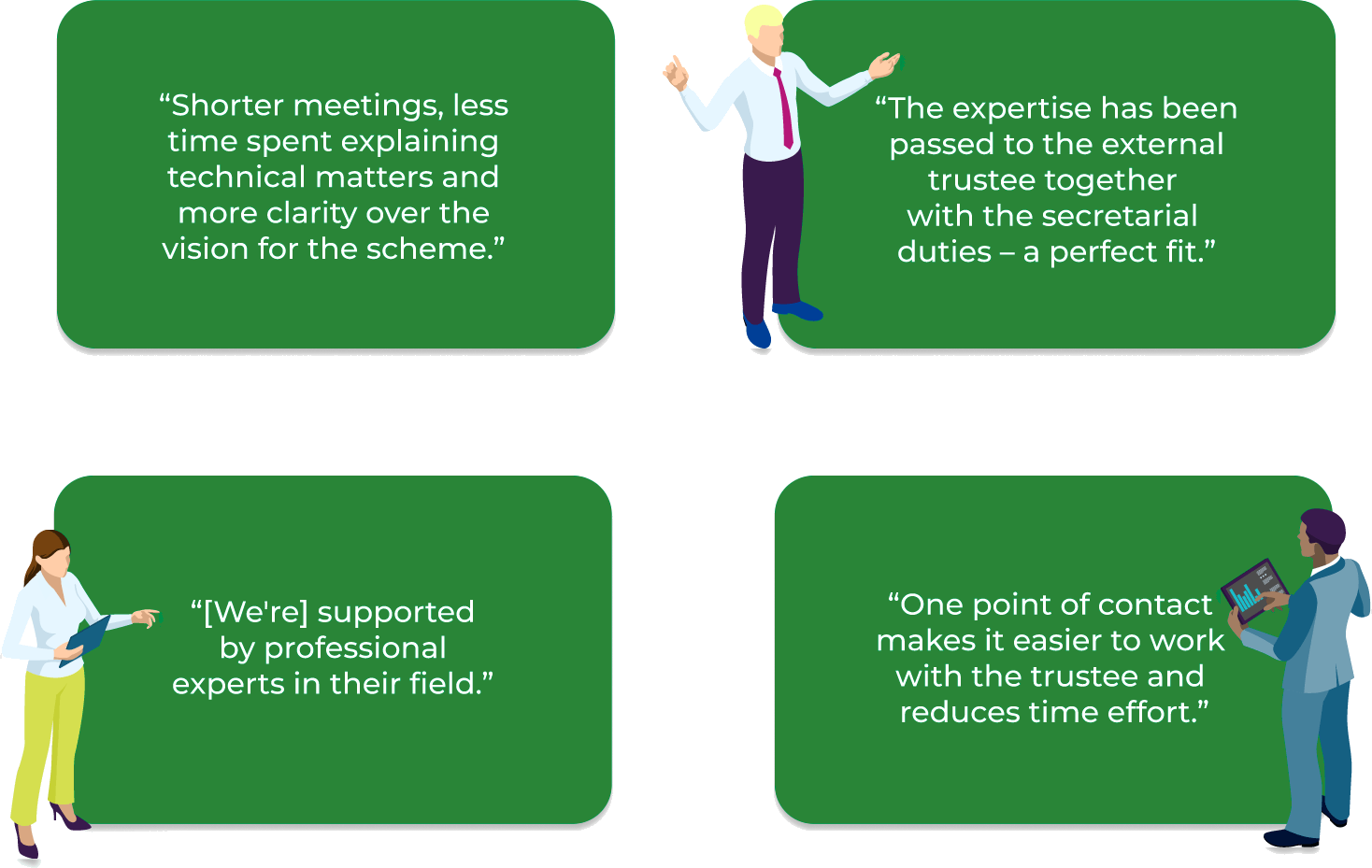
How sponsors describe the experience

Managing PCST trustee firms

Advisory firms are still refining how they resource and manage their PCST propositions, reflecting 
a market that continues to evolve.


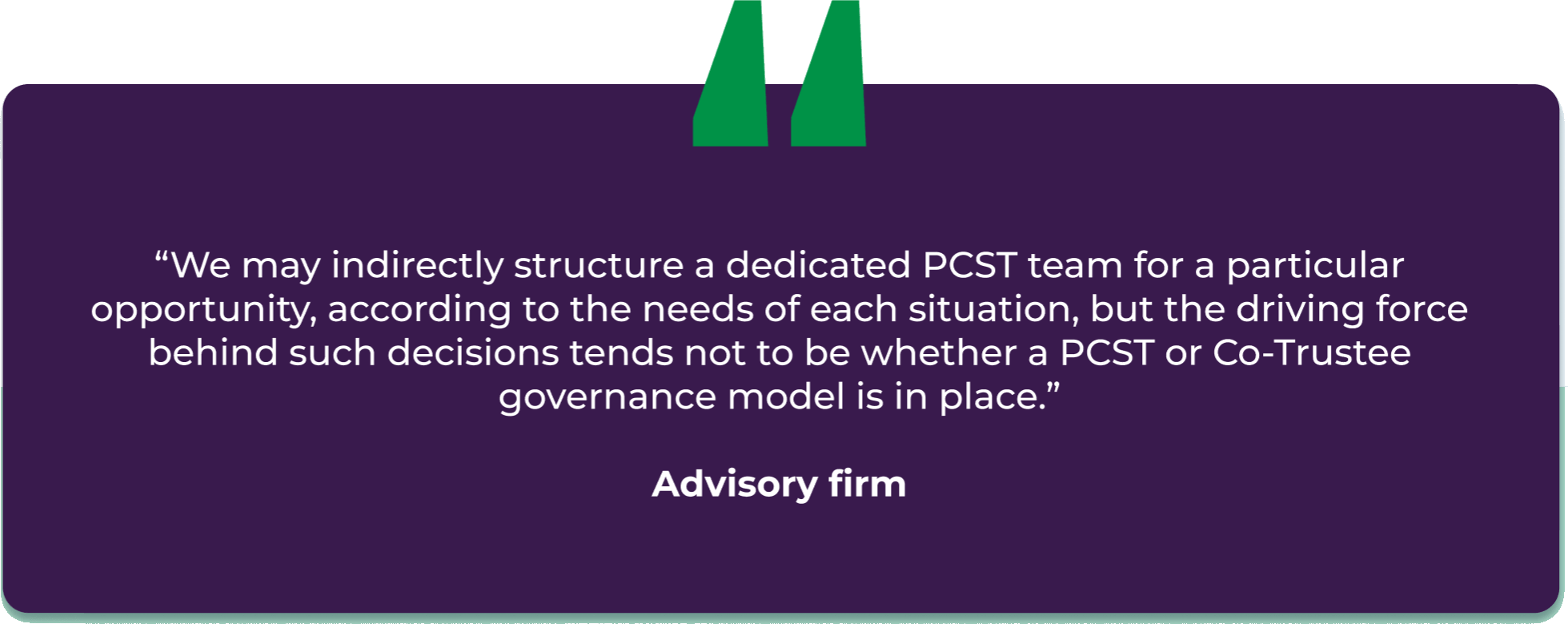
Just under half of advisory firms (42%, equivalent to 5 of 12 firms) now have a dedicated team in place to engage with PCSTs. Among the remainder, responsibility typically sits with senior leads overseeing the PCST proposition, supported by consultants who work across all trustee models rather than specialising exclusively in PCST.


Over the past year, most firms have maintained broadly the same operating structures, although some have made new senior appointments to strengthen oversight and capability.


Looking ahead, firms expect further proposition development in 2026 as PCST adoption continues 
and client needs evolve and become more defined.

PCST appointments by AUM

PCST scheme sizes

Portfolio data from eight leading advisory firms covering 400 PCST schemes shows that PCST adoption remains concentrated among smaller schemes.


  • 65% of PCST schemes have assets of up to £50m assets under management (AUM).

  • 83% fall within the two smallest size bands, with AUM of up to £150m.

While smaller schemes continue to dominate, this balance may shift over time. The same factors driving PCST adoption more broadly, increasing governance complexity, regulatory pressure and resourcing constraints, are becoming more relevant for mid-to-large schemes, suggesting the potential for a broader size profile in future.

While a small number of firms hold a meaningful share of large (£1bn+) PCST appointments, 
the majority of appointments across the market sit within lower AUM brackets.

Firms with the highest overall number of PCST mandates are typically concentrated in sub-£150m schemes, whereas those advising fewer schemes often have a higher proportion of larger, more complex appointments.

About The PCST Model

Bringing the findings together

The findings in this report point to a PCST market that has moved beyond early adoption and into a more mature phase of growth.

Adoption continues to rise, expectations remain positive, and the drivers of demand are increasingly structural rather than cyclical. At the same time, the research highlights a clear shift in how decisions to move to PCST are made, with sponsors taking a more proactive, strategic role as governance pressures increase.

While perceptions can still slow adoption, the experience of schemes operating under the PCST model consistently tells a different story. 
Once implemented, the PCST delivers measurable improvements in governance quality, decision-making speed, efficiency and access to specialist expertise.

For many schemes, the question is no longer whether PCST works, but when does it become the most appropriate governance model for their circumstances.

What the research shows about the benefits of PCST

Across sponsors and advisors, the benefits of the PCST model are clear and consistently reported:


Stronger governance
All schemes report improved governance, with a majority describing the uplift as significant.


Greater efficiency and reduced burden
Most sponsors spend less time on pensions, freeing up management and trustee capacity.

Deeper professional expertise
Professional trusteeship brings specialist knowledge into day-to-day 
decision-making, reducing reliance on education-heavy meetings.

Quicker, clearer decisions
Faster decision-making is one of the most frequently cited benefits, particularly for schemes managing complex activity or change.

These outcomes directly address the pressures driving adoption: rising complexity, regulatory scrutiny, succession challenges and the need for more resilient governance structures.

Why IGG?

Independent Governance Group has been at the forefront of the PCST market as it has evolved.


With a highly experienced professional trustee team in the UK, IGG supports schemes through the full PCST journey – from initial assessment and transition through to long-term operation. Our approach combines deep technical expertise with a practical understanding of sponsor priorities, ensuring governance works effectively in practice, not just on paper.


As the PCST market matures, schemes increasingly need a partner with the scale, experience and independence to deliver consistent outcomes over time.

Next steps

If you are considering PCST, reassessing your current governance arrangements, or simply want to understand what the findings of this research mean for your scheme, we would welcome the opportunity to discuss this with you.